Dining room ideas: panelling and dark walls
By the GlowUpp team · 27 October 2026
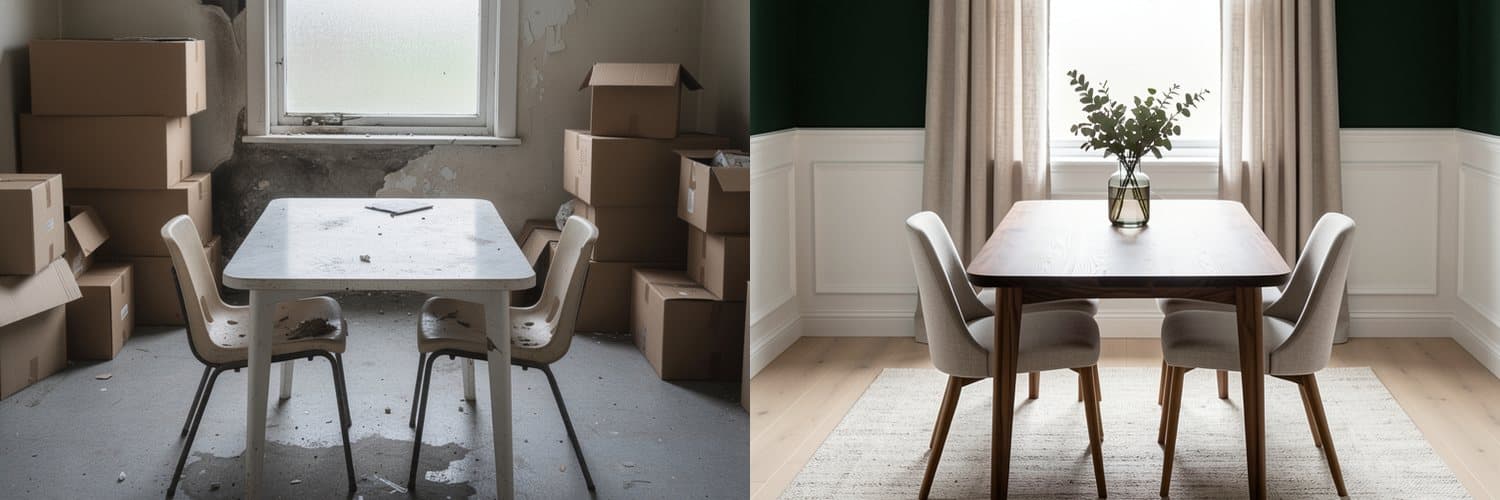 BeforeAfter‹›
An AI-generated example. Real results depend on your own space.
A dining room is mostly used in the evening, which makes it one of the best rooms for a dark, rich colour. Add panelling and good lighting, and a plain room becomes somewhere you want to sit for hours.
Why dark walls work in a dining room
Deep greens, navy and charcoal feel warm and intimate by candlelight and lamplight, and they make the table and the people around it the focus of the room. They also hide small imperfections in old walls. The key is to commit: a deep colour looks more confident across all the walls, and often the ceiling, than on one wall only.
Add panelling
Wall panelling adds depth and texture and protects the wall behind the chairs. It is often fitted to roughly between a third and half of the wall height, and painted the same colour as the wall or in a lighter shade for contrast. A joiner can fit it, or a confident DIYer can use ready-made panels. Either way, take your time over measuring and finishing.
Get the table and space right
- Leave about 90 cm around the table so chairs can be pulled out and people can pass behind them.
- Choose a table that fits the room and the people you really have to seat, not the biggest one that will squeeze in.
- A rug that is large enough for the chairs to stay on when pulled out protects the floor and anchors the room.
Light in layers
A single bright ceiling light flattens a dark room. Hang a pendant over the table at roughly 75 cm above the tabletop as a rule of thumb, add wall lights or a lamp on a sideboard, and put the lights on dimmers so you can set the mood for dinner or homework.
If your dining space is part of a kitchen
In an open kitchen-diner, use colour, a rug and a pendant to mark out the dining area without building a wall. A darker colour on the dining side can sit well next to a lighter kitchen, as long as they share a link such as the same wood or metal finish.
Mistakes to avoid
- Painting a dark colour only on one wall, which can look unfinished.
- Skipping the prep: dark colours show uneven walls, so fill and sand first.
- Relying on one ceiling light.
- Choosing a table that leaves no room to move.
See it in your own room
Upload a photo of your dining room to GlowUpp and see AI-generated versions with different wall colours and panelling, then share the one you like with a local decorator or joiner for a quote. Always ask a qualified professional before moving gas, electrics or plumbing, or changing anything structural, and check your lease or local rules if you rent or live in a conservation area.
See your own dining room redesigned
Upload a photo and see AI-generated ideas in about two minutes. Free for homeowners, no sign-up needed to start.
Try it with your photoCommon questions
- Are dark walls too much for a small dining room?
- Not necessarily. Dark colours can make a small room feel cosy and deliberate if you use them across all the walls and add good lighting. A dining room is mostly used in the evening, which suits them.
- What goes with dark green walls?
- White or cream panelling and woodwork, natural wood, brass or black details and soft linen curtains all work well with dark green.
- How high should dining room panelling be?
- A common approach is between a third and half of the wall height. Choose a height that lines up with a window sill or a picture rail so it looks planned.