Living room colour ideas: navy, sage green and warm neutrals
By the GlowUpp team · 27 October 2026
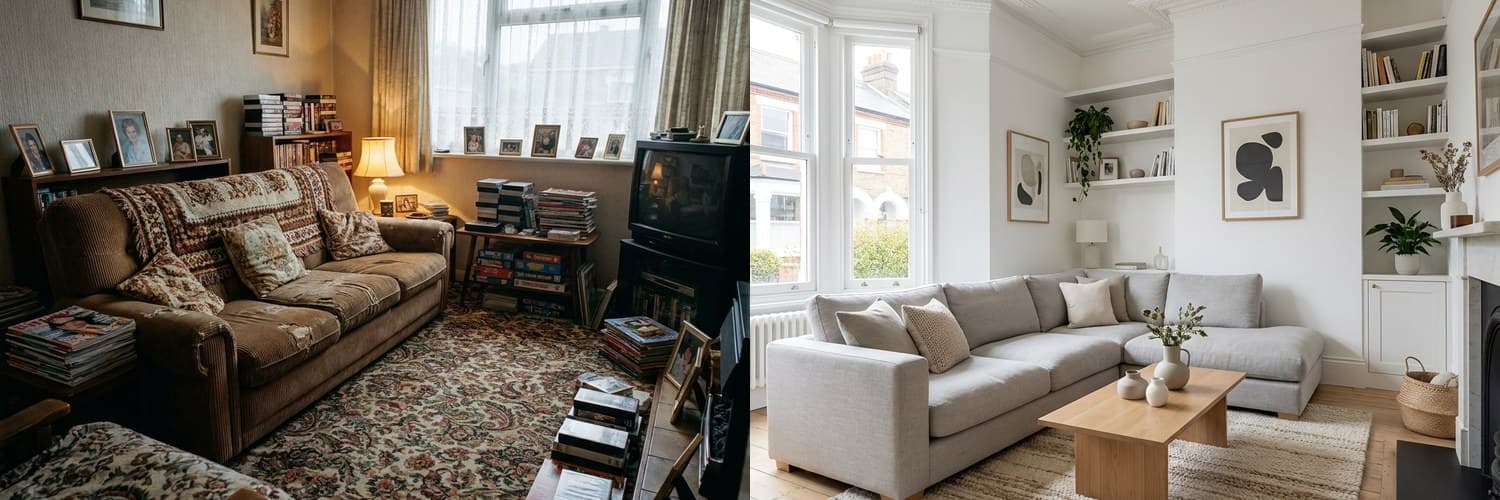 BeforeAfter‹›
An AI-generated example. Real results depend on your own space.
Colour changes a living room more than almost anything else for the money. The trick is to choose a colour that suits the light in the room and the way you use it, rather than picking one from a swatch and hoping for the best.
Look at your light first
North-facing rooms get cooler, softer light, which can make cool colours feel flat. South-facing rooms are warm and bright and can carry almost anything. Whatever the direction, the same paint looks different in the morning and the evening, so check it at both times.
Navy: cosy and confident
Deep blue gives a living room a sense of calm and works especially well in the evening. It pairs well with white panelling or white skirting, warm wood and brass or black details. In a small or dark room, use it on all the walls and let it feel like a deliberate, cosy choice, rather than on one wall only.
Sage green: soft and natural
Muted greens relax a room and sit comfortably with natural materials such as oak, linen and wool. They suit rooms with plants and good daylight, and they work in both traditional and modern houses.
Warm neutrals: easy and flexible
Soft creams, stone and warm greys keep a room bright and are easy to live with, and they let your furniture and art do the talking. If you worry about a room looking plain, add interest with texture, such as a rug, curtains and cushions, rather than more colour.
A simple rule for combining colours
A common design rule of thumb is about 60% a main colour (usually the walls), 30% a second colour (furniture and curtains) and 10% an accent (cushions, art and accessories). It stops a room from becoming a mix of competing colours.
Test before you commit
- Paint a large sample or use a sample pot on a big piece of lining paper and move it around the room.
- Look at it in daylight and with the lights on in the evening.
- Choose the finish too: matt is soft and hides flaws, while a slight sheen is easier to wipe clean.
Mistakes to avoid
- Judging a colour by how it looks on a screen.
- Forgetting the ceiling and woodwork, which change how the walls look.
- Using too many colours at once.
See it in your own room
Upload a photo of your living room to GlowUpp and see AI-generated versions with different wall colours and styles, then share your favourite with a local decorator for a quote. Always ask a qualified professional before moving gas, electrics or plumbing, or changing anything structural, and check your lease or local rules if you rent or live in a conservation area.
See your own living room redesigned
Upload a photo and see AI-generated ideas in about two minutes. Free for homeowners, no sign-up needed to start.
Try it with your photoCommon questions
- What colour makes a living room look bigger?
- Light, warm neutrals reflect the most light and make a room feel more open. A deep colour used confidently on all the walls can also work if the room has good lighting.
- Is navy too dark for a living room?
- Not necessarily. Navy works well in many living rooms, especially with white panelling, warm wood and good lighting. Test a large sample in your own light before committing.
- What goes with sage green walls?
- Natural wood, cream or white woodwork, linen and brass or black details all work well with sage green.